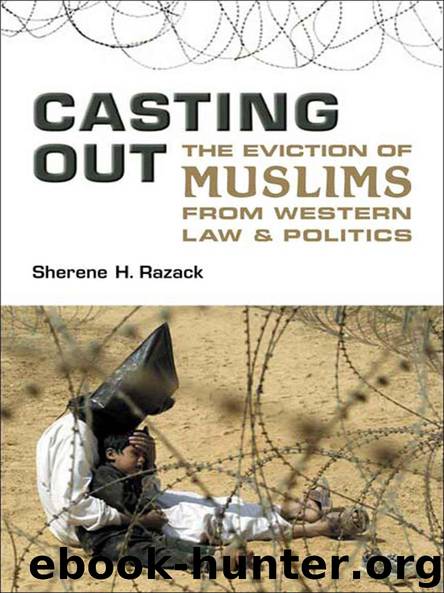
Casting Out: The Eviction of Muslims from Western Law and Politics by Razack Sherene
Author:Razack, Sherene [Razack, Sherene]
Language: eng
Format: epub
Tags: SOC031000
Publisher: University of Toronto Press
Published: 2008-01-05T05:00:00+00:00
Neo-colonialism: Hosts and Guests
The racial hierarchy evident in Generous Betrayal is naturalized through an appeal to a second underlying idea, one that explains immigration as an encounter between hosts and guests and that constitutes immigrants as foreigners against whom emerges what I have elsewhere called ‘original citizens’ (for the white settler context). Original citizens are those who bear an organic relationship to citizenship and whose claims rest on the basis of their having a natural entitlement (through descent from the ‘original citizens’) to full citizenship. Immigrants are scripted in this story as guests whose first obligation is gratitude to the hosts. The position is a catch-22. To belong, immigrants must indicate their gratitude and praise of the host culture, but since belonging is premised on membership in the bloodline that shares the nation’s history, to be an innvandrer or immigrant, as Marianne Gullestad has pointed out, is always to be non-Norwegian, compliance and good behaviour notwithstanding.44
The host/guest metaphor is a pernicious one, as Gullestad and others, including myself, have noted: ‘A host has the right to control the resources of the home, to decide on the rules of the visit, and, accordingly, to “put the foot down” when the guests do not conform. A guest, on his side has to be grateful for the hospitality received by not provoking the host by calling attention to his own difference from the host.’45 Gullestad reminds us that when white Norwegians are constituted as hosts and Muslims as guests, the latter permanently extrinsic to the nation and foreign, a moral community is created.46 Hosts have the moral right to call the shots, an assumption pervading government policies and laws on forced marriages. They have, in other words, a moral basis to instruct and to determine the conditions of daily life, while guests are always in the position of respecting the morality of the household.
It is worth taking the time here to draw out how hosts and guests are racialized categories that depend on specific silences. National mythologies are about an imagined sameness that comes about because a people have made a history together, a history of enterprise and innocence. In Norwegian national mythology, Norwegians courageously resisted the Nazis, something that does not bear up under close historical scrutiny. As a people, Norwegians have built a rich and peaceful land into which newcomers have come only recently. Here, for example, is how Unni Wikan tells the story of immigration to Norway. Immigrants, mainly of Pakistani origin, arrived in Norway in the 1960s, an event explained simply as men seeking a better life, or people were ‘invited to Norway as guest workers,’ as another Norwegian scholar Thomas Eriksen put it.47 Guest workers, who are never expected to stay long, soon brought their families and the non-European population grew. In this scenario, Norway does not need the labour of the ‘guest workers,’ and if it has benefited at all from their presence, this is only coincidence. Norway imposed a ban on immigration in 1975, leaving the doors open only for family reunification and asylum.
Download
This site does not store any files on its server. We only index and link to content provided by other sites. Please contact the content providers to delete copyright contents if any and email us, we'll remove relevant links or contents immediately.
| Anthropology | Archaeology |
| Philosophy | Politics & Government |
| Social Sciences | Sociology |
| Women's Studies |
Nudge - Improving Decisions about Health, Wealth, and Happiness by Thaler Sunstein(7678)
The Fire Next Time by James Baldwin(5409)
iGen by Jean M. Twenge(5398)
Adulting by Kelly Williams Brown(4550)
The Sports Rules Book by Human Kinetics(4367)
The Hacking of the American Mind by Robert H. Lustig(4355)
The Ethical Slut by Janet W. Hardy(4232)
Captivate by Vanessa Van Edwards(3826)
Mummy Knew by Lisa James(3670)
In a Sunburned Country by Bill Bryson(3521)
The Worm at the Core by Sheldon Solomon(3467)
Ants Among Elephants by Sujatha Gidla(3449)
The 48 laws of power by Robert Greene & Joost Elffers(3201)
Suicide: A Study in Sociology by Emile Durkheim(3001)
The Slow Fix: Solve Problems, Work Smarter, and Live Better In a World Addicted to Speed by Carl Honore(2990)
The Tipping Point by Malcolm Gladwell(2895)
Humans of New York by Brandon Stanton(2859)
Handbook of Forensic Sociology and Psychology by Stephen J. Morewitz & Mark L. Goldstein(2687)
The Happy Hooker by Xaviera Hollander(2678)
